This is my new domain name randylinguitar.com. I’m so happy to have an easy to find name. Look soon for sheet music and CDs. Always more forthcoming from Randy Lin Guitar.
This is my new domain name randylinguitar.com. I’m so happy to have an easy to find name. Look soon for sheet music and CDs. Always more forthcoming from Randy Lin Guitar.
This question is important, especially for young musicians, because they often jump before looking when they hear the words “performance” or ” paying gig”. Many times these “opportunities” are merely opportunities to be used by someone.
Take for example a recent ” opportunity” to play an outside gig. The pay was good, but not in comparison to the time required to play (3 hours).
This gig was in a square surrounded by restaurants blasting their own music for their outside customers. At the same time, there were volume limits placed on the performer, who, even when the restaurants were quite, was barely audible.
No one was really paying attention to the performer, thanks to the sports TVs in the outdoor dining areas. The performer went thru song after song with barely any interaction or applause between numbers.
These kinds of “opportunities ” are unhealthy for young performers. They damage confidence by making he or she ask “do I suck,” when the real problem is threefold: the venue, the requirements, and yes, the audience, all suck!
So what’s a good opportunity? It’s one where you are advertised and annouced. It’s one where people are there for the show, not background music. And it’s one where you feel good about the amount played to the amount paid ratio.
It takes time and experience to learn how to vet these opportunities. As a person with over 40 years experience, I’ve run into a few nightmare gigs. Hopefully, I can help you avoid those.
Perfectionism is bad enough. always pushing yourself to ever specific corrections in technique, tone, and phrasing. But whats worse is perfection itself.
Its been said that perfection is the enemy of everything good. But its also true that perfection is the enemy of creativity. I call it the “Heisenberg Paradox of Music”. In physics, Heisenberg stated that you could either know the position of a particle OR its speed, but never both.
In Music, you can either play perfectly or play creatively but not both. Why? Because what makes a player unique are his/her limitations as well as abilities. Every great musician I can think of has some quirk or limitation that made them what they are. BB King said he couldn’t play and sing at the same time, so you hear him sing a line then play a line. Pat Metheny said he learned to hold his pick wrong, so he developed beautiful left hand hammer on and pull off lines. And so on. Time and again we see that what makes a person unique is their limitations, for which they must use creativity to overcome.
Does this mean I’m anti technique? Not really. But I have to say, the musicians I’ve seen whom seem to have no limits in technique dont score highly in the creativity department. They don’t have to. They can play in all keys equally and have few if any limitations to overcome. But i seldom recognize one of those musicians from the other. They are the finished product of their education. Unfortunately, They lost their individual voice.
So what am I saying? Maybe less time on the technical more on the expressive. Maybe that’s what we need in music.
Everybody’s workflow is different when it comes to music production. And different workflows often require different tools. What’s touted as the “newest and best” isn’t always such for everyone.
To me, there are three parts that need to be addressed:
Some people find all of the above in a DAW software. I used to be happy in that, but my fav softwares have either gone the way of dinosaurs or have been altered for the 2020s in ways that I find unsatisfactory, including being subscription based rather than bought at one time.
So I’ve searched. Two credit cards worth of searching. But I’m pretty much set on the following:
guitar– overdrive–delay–looper with song save slots and USB, all on a pedalboard
Having this at my feet inables me to work intuitively and add parts quickly. The finished product is USBed to my computer for editing and posting.
What loopers are available for this? The Boss RC5 is a good one, as well as the older RC3 and the Digitech Jamman Solo XT. I beleive in keeping computers for what they do best- final finishing and rendering to a shareable medium.
Keeping it simple in music production is the only way to go. Never look down on your rig as long as it can cover the above three points effectively.
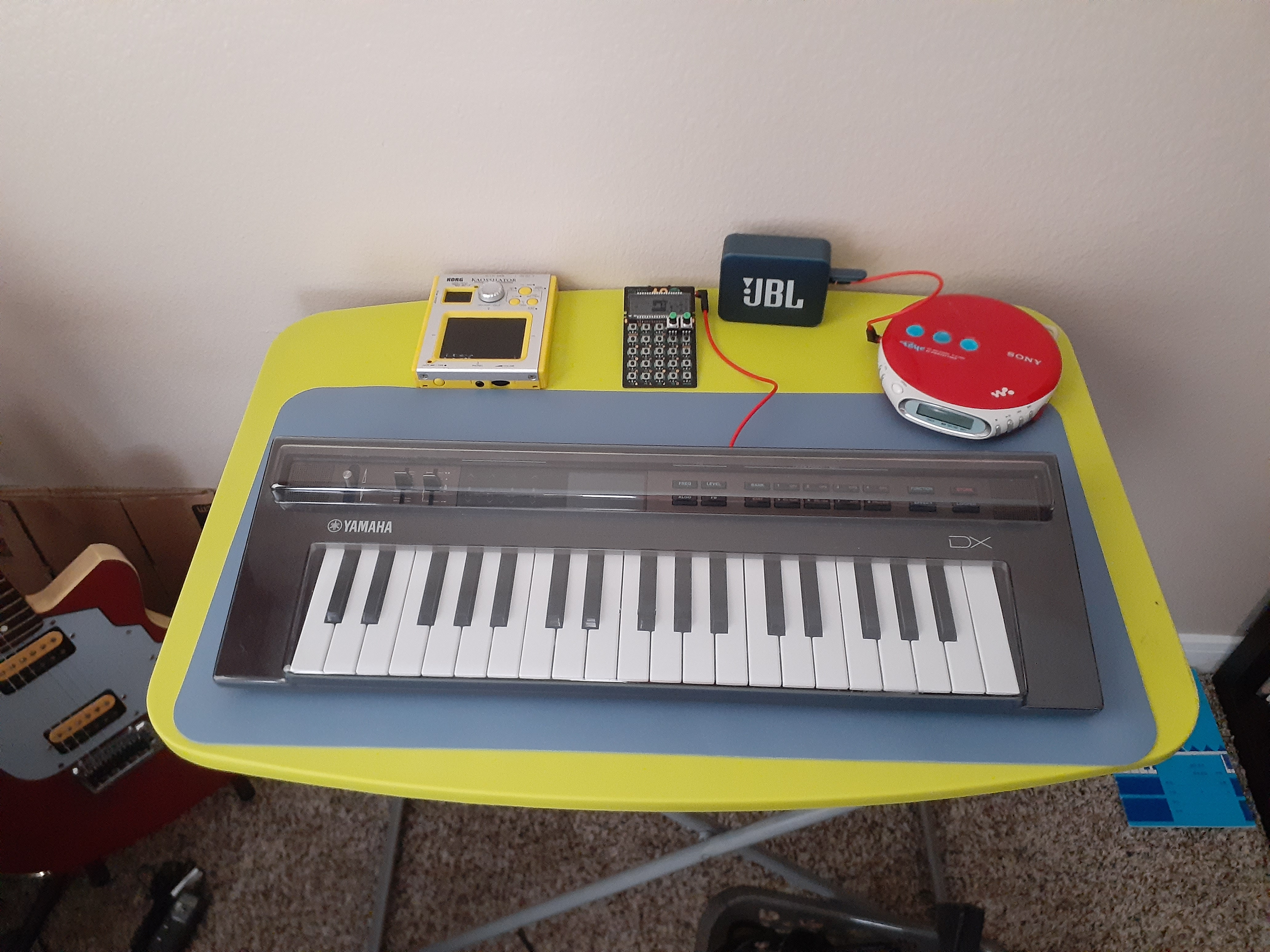
We just moved into our new apartment and while getting the kids room ready, I marked out my little music corner in the living room, right next to the balcony window, separated by a bookshelf next to the sofa. It’s a really cozy, inspiring workspace. I’m really minimalist for this worktable , just my DX Reface Synth and a couple of drum computers, recorded directly into my Zoom H1n. The table I found near the garbage bin, and the Amazon Basics computer pad makes for some radical contrast color. It’s a fresh palette to me.
So when will I record some new stuff? Hey, its summer and I’m melting. But once these kids get back to school, I’m getting some music done. I’ll post some then. See you.
I find that Jazz has recently been the subject of much musical snobbery, especially since educational institutions have been trying to make it the new classical. You’d be surprised at the number of people who have asked me what school i studied jazz at or which jazz school is the best.
This has always puzzled me, because in my opinion, jazz is a folk art form. This seems strange to say considering that jazz has always been connected to the urban environment, but nevertheless, so are other art forms such as rap and def poetry.
To me, jazz is simply playing the melody and playing with melody. The techniques to do this are more from the ear than from the textbook, though textbooks can analyze and codify them. But then you have to ask yourself if you want your jazz to sound ” analyzed and codified”. Spare me.
Herein lies the problem with trying to make jazz the new classical. Yes there are jazz theories and approaches. At this stage in my life, I know them all. I can tell you that none of them beat time spent on the fretboard, learning the melody then bending it in various ways that are discovered spontaneously and organically, then honed through conscious practice until they become second nature.
One can only do this if he or she spends a lot of time listening to jazz until something sticks that you really want to play. Finding good jazz to listen to is key.
I for one love smooth jazz. I don’t apologize for it no matter what the jazz snobs think of me. Smooth jazz is the best way to get into jazz playing. Then move up to cool jazz with Miles Davis. Then go on to Wes Montgomery and John Coltrane.
Take it step by step, listening to what these masters are doing with the melody. Be able to sing what they’re doing before you try to play it. This will make everything you do spontaneous.
Get to work.
Planning up some new gigs in Bryan, TX for 2021. I hope Covid will be in its last throes and when it is, my venue people will move on dates and times for some shows for you all.
I’ve become quite tired of pedals recently and sold all but two of my favorite ones. I got tired of power supplies, so many connectors, tone mismatching and so on.It was thus that I started looking at “all in one” modeling amps as a way forward into my 40th year (yikes) of performing.
I have had Roland’s Microcube in two incarnations ( original and gx) and found them to be a really useful kind of everything you need in a small box. I’m waiting for a possible upgrade from that to come out this year.
But the other amp that has my attention recently is the Yamaha THR5. I’ve got to say, for feel, the THR has the Microcube beaten by a long shot. The amp models feel and sound like a real amp, no digital tizz or runaway gain. The interface is simpler, with everything laid out in a horizontal line. The only thing I can fault it on is the tremolo setting, but Yamaha gives you free software to access that and some hidden features, as well as recording software to make use of its USB output.
So what can I say? I’m set on the THR5. I’m not even advertising for them. This is, to me, the best small amp available. I’ll miss the Microcube’s acoustic emulation setting. Maybe Yamaha will have that in the software. Anyway, I hope to play it for you at a show soon.
The Safe Life Is Most Dangerous (Antei No Seikatsu Wa Ichiban Abunai!)
“Nothing is more dangerous than the ‘safe life’.
The risk you don’t take, is the life you fake.
The truth you don’t say, is the lie you pay.
The chance untaken, is a dream forsaken
Love unspoken, is a life that’s broken
The race you don’t run, is your life undone.
And the one who no longer tries is the one who truly dies”.
-Randy Lin
Remember that a musician must take risks. Safe music is no music at all.
 randy lin guitar