Is Jazz Really That Difficult?

I find that Jazz has recently been the subject of much musical snobbery, especially since educational institutions have been trying to make it the new classical. You’d be surprised at the number of people who have asked me what school i studied jazz at or which jazz school is the best.

This has always puzzled me, because in my opinion, jazz is a folk art form. This seems strange to say considering that jazz has always been connected to the urban environment, but nevertheless, so are other art forms such as rap and def poetry.

To me, jazz is simply playing the melody and playing with melody. The techniques to do this are more from the ear than from the textbook, though textbooks can analyze and codify them. But then you have to ask yourself if you want your jazz to sound ” analyzed and codified”. Spare me.

Herein lies the problem with trying to make jazz the new classical. Yes there are jazz theories and approaches. At this stage in my life, I know them all. I can tell you that none of them beat time spent on the fretboard, learning the melody then bending it in various ways that are discovered spontaneously and organically, then honed through conscious practice until they become second nature.

One can only do this if he or she spends a lot of time listening to jazz until something sticks that you really want to play. Finding good jazz to listen to is key.

I for one love smooth jazz. I don’t apologize for it no matter what the jazz snobs think of me. Smooth jazz is the best way to get into jazz playing. Then move up to cool jazz with Miles Davis. Then go on to Wes Montgomery and John Coltrane.

Take it step by step, listening to what these masters are doing with the melody. Be able to sing what they’re doing before you try to play it. This will make everything you do spontaneous.

Get to work.

What’s my backline? And is equipment THAT important?

Living(until recently) in very crowded Taiwan for over 20 years, I have become somewhat of a “compact” person. No i don’t mean I got squished on the subway (though that has happened). I mean traveling light but having the most important things for a gig. Certain items have become indispensable for me and I’ve always come back to them for my gig carry. Your mileage may vary:

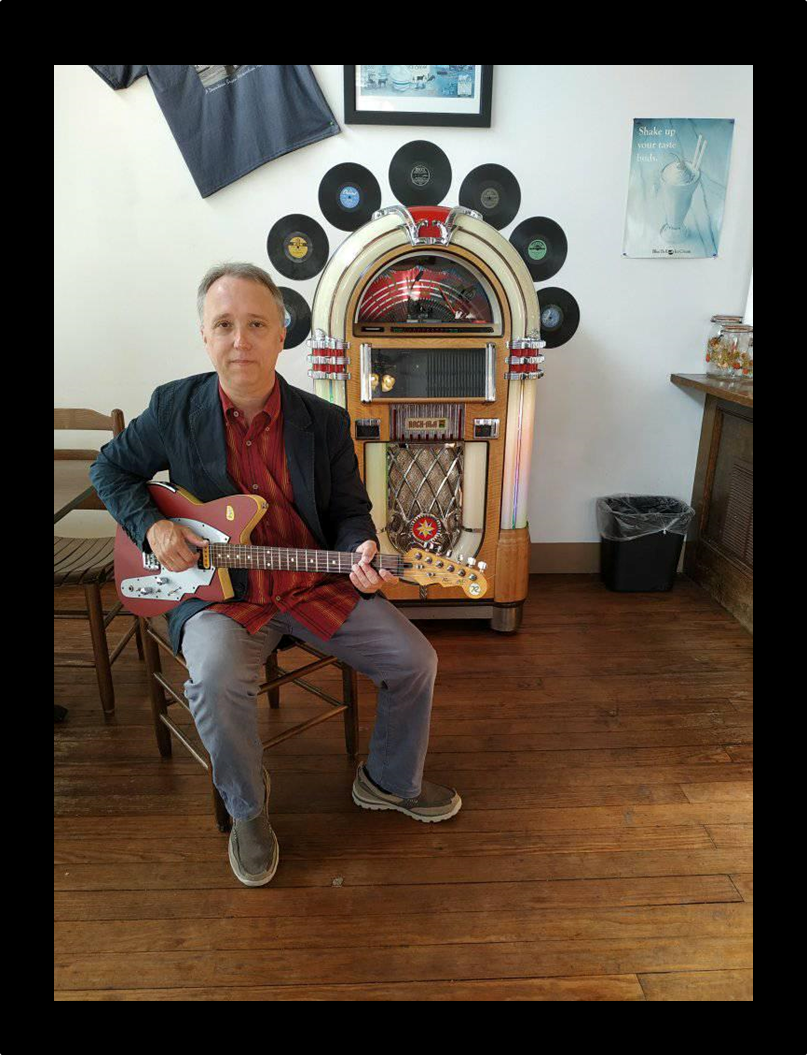
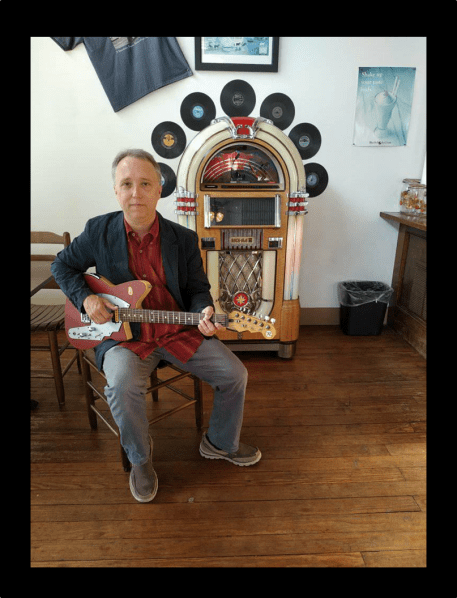
Guitar- this is really a personal preference. Mine is a Reverend Rocco USA with humbuckers and tremolo. I can get most sounds I want with it, and if I set it up just before the show, it plays great all night.

Amp- I have to say. the Roland Micro Cube GX is still the most practical amp around. I sometimes like to do acoustic stuff, so the acoustic simulator in it is great for me. Reverbs and delays are good as well as the chorus and overdrive.

Effects- really i only need a looper going direct into the microcube on a jazz setting. Most of my playing is solo style with chords, bass, and melody together because I come from an acoustic guitar background, which included Travis picking, jazz chord melody, and blues fingerpicking. But for some things, I like to single line solo using a looper. Lately I’ve been using a TC Ditto, but I’m thinking of getting a Boss RC1.

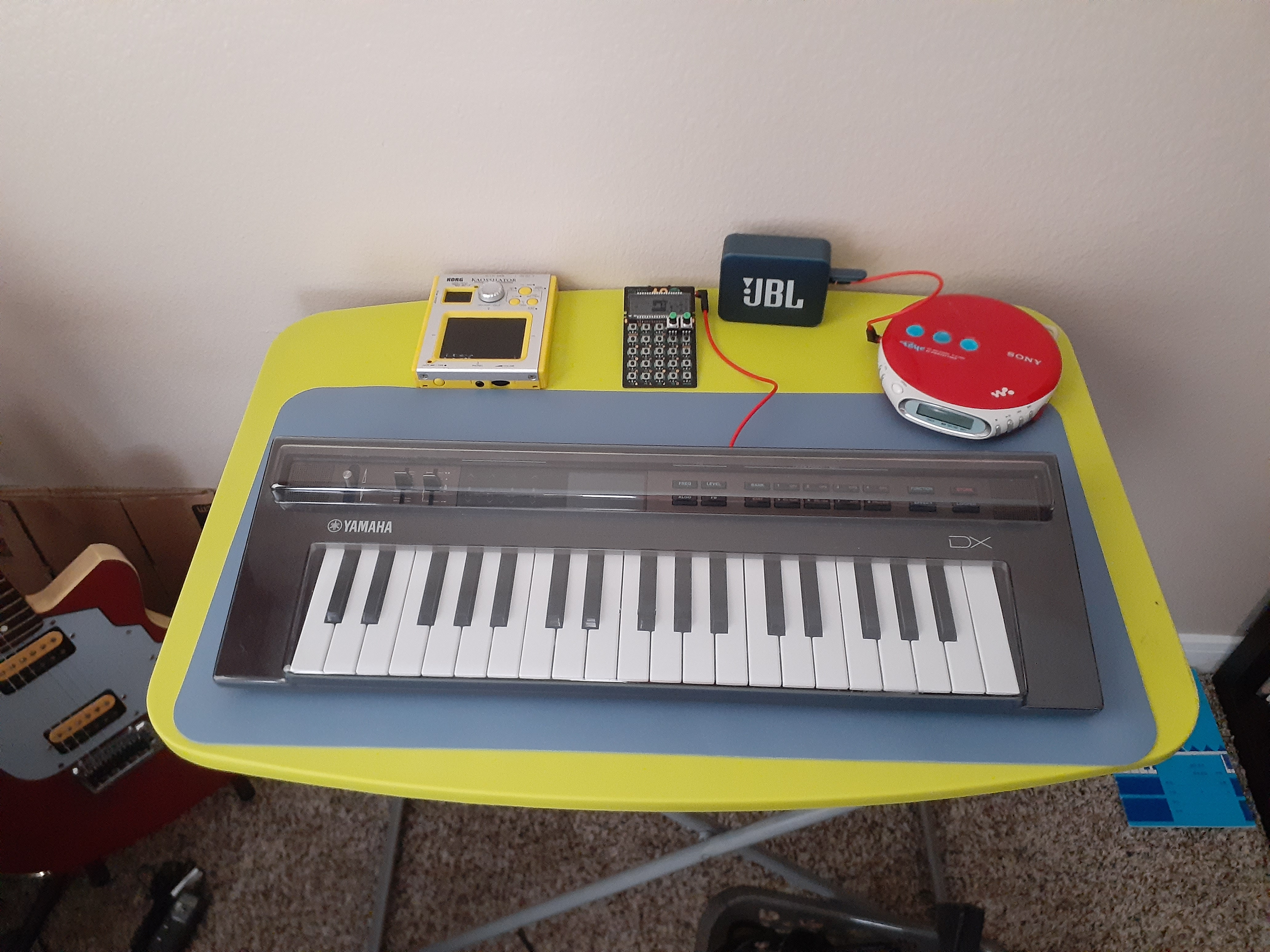
Keyboard- yes I play some keyboard with vocals in my shows. I just bought a Yamaha DX Reface for that. The mini keys are a little bit nerve racking, but I’m getting used to them.

Mic- I have a Mackie Element vocal Mic. It’ll do.
Cases and transport- everything has its own padded gigbag and is pushed on a dolly. I’m not doing any more heavy lifting at my age.

I might get a Behringer Compact PA for street festivals.
Hope to do that and see you all soon.

Best Small Modeling Amps

I’ve become quite tired of pedals recently and sold all but two of my favorite ones. I got tired of power supplies, so many connectors, tone mismatching and so on.It was thus that I started looking at “all in one” modeling amps as a way forward into my 40th year (yikes) of performing.

I have had Roland’s Microcube in two incarnations ( original and gx) and found them to be a really useful kind of everything you need in a small box. I’m waiting for a possible upgrade from that to come out this year.

But the other amp that has my attention recently is the Yamaha THR5. I’ve got to say, for feel, the THR has the Microcube beaten by a long shot. The amp models feel and sound like a real amp, no digital tizz or runaway gain. The interface is simpler, with everything laid out in a horizontal line. The only thing I can fault it on is the tremolo setting, but Yamaha gives you free software to access that and some hidden features, as well as recording software to make use of its USB output.

So what can I say? I’m set on the THR5. I’m not even advertising for them. This is, to me, the best small amp available. I’ll miss the Microcube’s acoustic emulation setting. Maybe Yamaha will have that in the software. Anyway, I hope to play it for you at a show soon.

A Poem I Wrote About Courage

randy texas

The Safe Life Is Most Dangerous (Antei No Seikatsu Wa Ichiban Abunai!)

“Nothing is more dangerous than the ‘safe life’.
The risk you don’t take, is the life you fake.
The truth you don’t say, is the lie you pay.
The chance untaken, is a dream forsaken
Love unspoken, is a life that’s broken
The race you don’t run, is your life undone.
And the one who no longer tries is the one who truly dies”.
-Randy Lin

Remember that a musician must take risks. Safe music is no music at all.

The Importance of Etudes in Music Study

When I was in college, I was really blessed to be friends with a pianist from China named Chen Bi Nou. In case you don’t know who he is, there’s a film somewhere of President Nixon visiting China in 1973, and a young Bi Nou playing for him. He had been selected from all of China for this important event of East meets West.
Fast forward 15 years later, and east met west again, and I learned one of the most important things in music from it:
NEVER PRACTICE SCALES!
I had asked Bi Nou what exercises he did to play so smoothly, and he had this to say:
” Scale are useless. I practice songs and etudes. I just find a composition that has everything I need in it and practice that. If you just practice scales you can only do the scales, but if you practice compositions, you have all the practice you need, plus something to play for people.”
This statement went from my young ears to my big mouth, and soon everyone in the music department knew my newfound philosophy, and where I got it. This got Bi Nou a little bit of criticism from my piano teacher, but Bi Nou stuck by his philosophy. And I do too.
I’m not saying one should not learn scales. You have to know what the scales are and their fingering to be able to recognize and play them in a composition. So there is, as my other teachers fought so hard to defend, a need in the beginning to practice scales. But once the scales are learned, one must not stay there, but begin their practice in another context, that of etudes and compositions. No more time must be wasted on the solo practice of scales.
I’ve kept to Bi Nou’s philosophy for decades now. And I always thank him for teaching me.
Try it yourself, and streamline your practice and repertoire.

The Story Behind Tokyo Love

In 1991, I had an opportunity to go to Japan, my first time abroad. I had about 6 months to prepare the money to go. I was living in Houston’s Chinatown, barely getting by as a busboy. My income got so low that i was actually homeless for, thankfully, an hour. Nevertheless, songwriting was going good and was about to get better.
I left Chinatown for a brief time to move in with my brother near River Oaks district. This was the first time I had been exposed to what was (in the 90s) a very free and artistic area to live in. I had never lived in a soho, and i was really inspired by the many shops and bookstores.
But Chinatown never left me. Right down the street across Westheimer was Auntie Chang’s Dumpling House, still there to this day. I got a job as busboy all day until 5pm. My favorite thing at that age of 24 was to take my tip money, get on the Westheimer 85 and stop off at Miyako’s for sushi happy hour (and to see a waitress, which made it a very happy hour, of course). Then I would take my transfer, continue down Westheimer to the second run movie theater, dream about asking my waitress to the movie, catch Bill and Ted’s Bogus adventure, then take the 85 back home.
The other crazy thing was I was also in love with a girl at a karaoke near Beltway 8. I used to go sing for her every Friday. It turned out she knew my boss and passed her number thru him to me. WOW!
Somehow, I didn’t call her. But I went to the karaoke that night and asked her out. She said she was busy. This was actually the last night my brother and I could keep that apartment. He was moving in with friends and the landlord was renting it out. But i met a guy who invited me to be his room mate. He liked Japanese culture, so we attended the Houston Japanese Church together.
It was then I knew why I was there.
I became one of the pianists for the church. And i was asked by a pastor to visit Japan. That sparked me. I got a job and started saving for the trip. Then I borrowed a keyboard and wrote three songs, the surviving of which is Tokyo Love.
That song enveloped my hopes in japan. It’s innocent, maybe even a little corny by today’s standards, but I think it stands as a great song. 30 years later, one of my students loves it. I still do, too.